
Where should your first AI investment go?
Choose a recurring task with accessible inputs, an accountable owner and a result you can measure. Use this screen to compare the candidates.
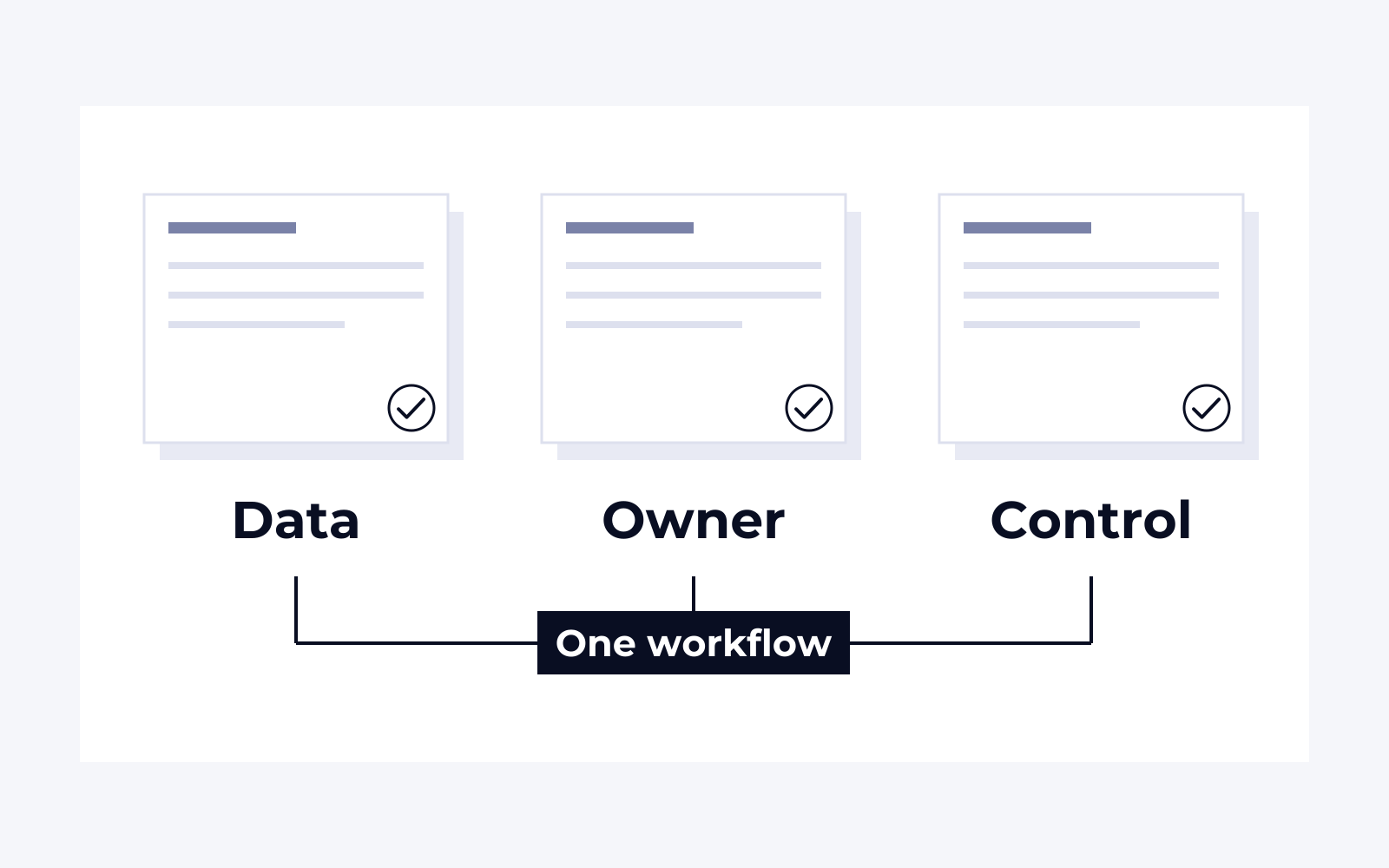
Start with a recurring workflow where the team can inspect real inputs, measure the current burden and correct a bad result. An order queue, support request or intake process can be a better first investment than a broad assistant if the work and its owner are clear. The right choice depends on the constraint, not the appeal of the demonstration.
Start with the work people actually do
Follow a transaction from request to completion. Watch the handoffs, inspect the systems, and ask the people doing the work where they lose time. A process diagram is a starting point. Recent transactions reveal missing information, exceptions and the workarounds people use to finish the job.
Consider a hypothetical distributor whose sales team struggles to prepare quotes. The apparent opportunity is automated proposal writing. Observation might reveal that writing takes little time; finding current specifications and resolving conflicting price records causes most of the delay. Those are different problems, with different solutions.
Compare the candidates on the same evidence
Put each candidate on a one-page brief. Name the affected customer or operating result, show the source records and describe what an improved transaction would look like. Include the strongest alternative to AI, such as a repaired integration or a simpler approval rule. Compare the proposed approaches against the same problem.
For each candidate, record:
- Consequence: What business result suffers, and who can verify it?
- Frequency: How often does the problem occur, including exceptions?
- Readiness: Can the team access reliable inputs and an authorized place to act?
- Control: Can errors be detected, contained, and corrected?
- Ownership: Who will change the workflow and remain accountable after launch?
A common scale can help a team discuss candidates consistently. It does not turn incomplete evidence into certainty. Mark unknowns explicitly and investigate the ones that could change the decision.
Separate the problem from the proposed technology
Some friction needs clearer rules, a repaired integration, or better source data. AI may help interpret variable documents or draft responses, while a conventional application should enforce pricing rules and record approvals. Funding the useful combination requires understanding the whole workflow.
In the hypothetical quoting example, a first investment might combine a reliable product lookup with AI-assisted interpretation of customer requests. A salesperson reviews the suggested items before an existing pricing service calculates the quote. Each component has a defined job and a testable result.
Choose a bounded improvement with a baseline
Favor a candidate with recurring demand, accessible evidence, a willing owner, and consequences the team can manage. A highly valuable but poorly understood workflow may need discovery before it deserves a build budget.
Establish the current completion time, correction rate, volume, and cost of handling exceptions. Measure the full path to an accepted outcome. Faster drafting provides little operational benefit if reviewers spend longer repairing drafts or waiting for missing information.
Leave the comparison with a funding decision
Bring the workflow owner, an operator, an engineering lead and a finance partner together to compare three candidates. Record one of these decisions for each, with the evidence that supports it:
- Build a bounded release: representative inputs are accessible, a team owns the destination workflow, the result can be checked and a baseline exists. Define the supported cases and the stop conditions.
- Prepare first: the opportunity appears worthwhile, but access, source quality, business rules or ownership is unresolved. Fund that specific prerequisite before estimating the full build.
- Use a simpler change: the main delay comes from a broken connection, unclear policy or unnecessary handoff. Fix that constraint and reassess whether AI still adds value.
A first investment brief should state what will change, who will use it, how the result will be reviewed and what evidence would justify expansion. If an error cannot be detected before its consequences become unacceptable, narrow the authorized task. Do not leave that decision until implementation.
Which workflow deserves the first investment?
Bring three candidates, a few recent transactions and the people who own the work. We’ll help you compare the evidence.